
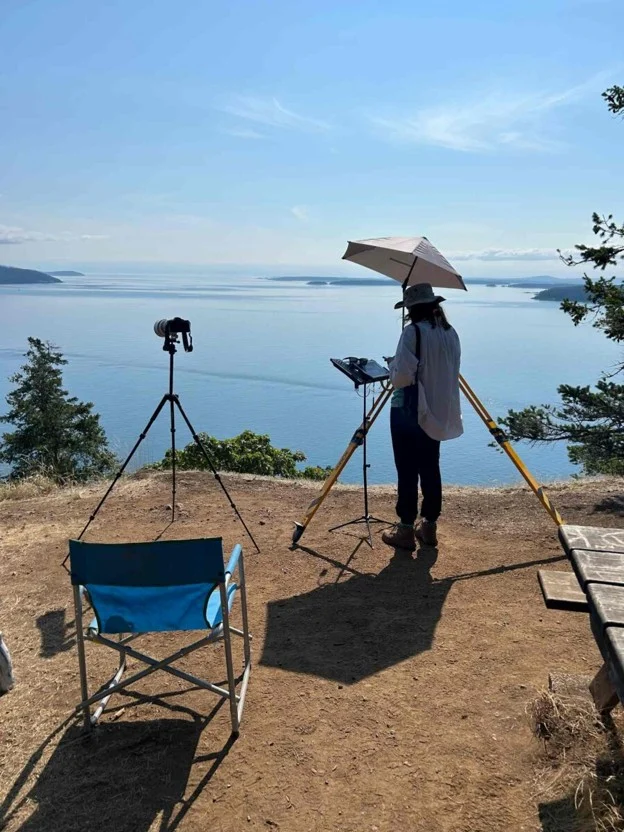
Janine McNeilly is a research scientist for Raincoast’s Cetacean Research Program. A lifelong whale lover, Janine is working to help us understand the effectiveness of Vessel Restricted Zones in Southern BC.
Her fieldwork takes her to the rugged coastlines of Pender Island, where she observes whales from a bluff overlooking the Salish Sea. Janine sat down to chat about cetacean conservation, community science, and her favourite whales.
Where did you grow up, and where are you living now?
I’m from Coquitlam, which is a suburb of Vancouver in British Columbia. I’m currently on Pender Island, one of the Southern Gulf Islands between the Lower Mainland and Vancouver Island.
Tell me about your current project.
We monitor the Pender Vessel Restricted Zone (VRZ), which is a seasonally enforced vessel-free area in the Southern Gulf Islands. There’s one off Pender Island, and one off Saturna Island. These zones were put in place to try to protect the Southern Residents from the physical and acoustic disturbances caused by vessels. These two small strips of ocean were chosen because, historically, there have been a high number of Southern Resident sightings in these locations. When the whales come into the Salish Sea, they have a little protected zone that they can swim through.
I stand on a cliff, and I look out over the ocean. I have this cool instrument called a theodolite that allows me to track the exact locations of any whales or boats that go through the study area. I track Southern Residents, Bigg’s (transient) killer whales, humpback whales, and any other whale or dolphin that pops up. I also track all the boats that transit through the area, which helps me determine the compliance rate with the VRZ.
This project allows us to determine what types of whales are common in this area, how boaters behave around whales, and whether whales are using the zones. There’s a lot going on.
What’s your impression of the compliance rate? Do you feel like people are generally respecting it, or is it the wild west?
It’s the wild west for sure. Commercial vessels tend to respect the zone because they have AIS transponders on their vessels. If you have AIS and you go into the zone, you’re automatically reported to Transport Canada. The zones are also pretty close to shore, so really big commercial ships typically wouldn’t enter them. Small recreational vessels sometimes do.
Last year, we reported over 800 infractions in the Pender VRZ. There’s obviously more that we don’t see that happens after monitoring hours or on days we’re not working. There’s also just so much vessel traffic in the area; we probably tracked multiple thousands of boats last year. So overall compliance is hard to tell, but it’s not perfect.
Do you see whales most days? Or is that more of a rare occasion?
I’m up there from May through October, so it varies depending on the time of year or even what year it is. May is a big humpback month; we had humpbacks almost every day during the second half of May in 2025. We also had a lot of Bigg’s killer whale sightings last year, way more than we had in 2024. I would guess we see whales about every three days, give or take. But there’s always a harbour porpoise! They’re there if you look hard enough.
Thank you to the Raincoast Conservation Foundation for providing this excerpt.