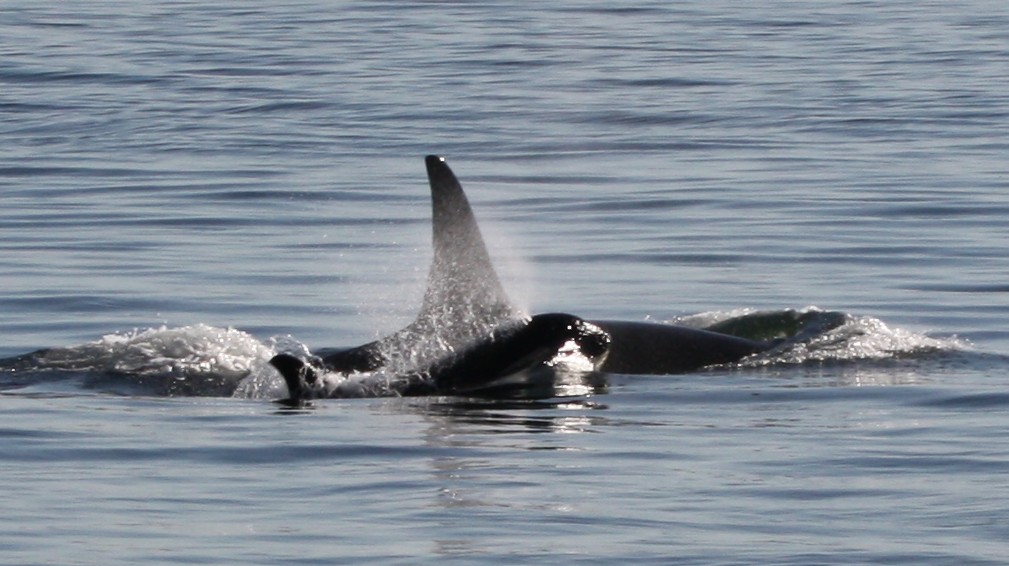
Photo of Southern Resident Killer Whales off Pender’s coast in August, courtesy of Graham Elder.
By Noémie Crépeau
As a kid, I was very fond of cetaceans. In my bedroom, I had a big poster showing different species organized by size. I listened to whale songs to fall asleep. I memorized whale facts.
It ran in the family. In our living room, the classic Bob Talbot picture frames popular in the 80’s adorned walls. For many summers, until I grew into a too-cool detached teenager, my parents and I traveled up the northern Quebec coast in a camper van, visiting nautical towns and villages and going whale watching. Places like Tadoussac and Mingan islands became familiar, as did water and land excursions sighting my favourite, beluga whales, and other Atlantic ocean giants like humpbacks, blue whales, grey whales, and once a narwhal. What a lucky kid!
In hindsight, it’s no surprise that after trading coasts for this one, I ended up on Pender Island, a true whale lover’s paradise! The very day we moved here from Vancouver, sitting in our new island beater truck, several orcas put on a show just outside Galiano’s Sturdies Bay. Elated, if ever there was a sign for making the right move, this had to be it.
Penderites’ love for whales, especially orcas, runs deep, and it’s embedded in the local culture. We get to see and hear porpoises, humpbacks, orcas, and the occasional fin whale. The ancient line of Southern Resident Killer Whales (aka SRKW) who hunt salmon in Pender’s waters are beloved creatures. You will see them in local art, landmarks, tourist mementos, and informational posters at popular view points. We’re on the Whale Trail.
J-Pod, K-Pod and L-Pod are known to us. Every new calf is a blessing; Pender collectively hopes it survives its first year, tipping their population over 74. As of today, two new calves have joined L-Pod this year, and time will tell if we’ve lost any family members or if we’ve reached 76.
Humpbacks are increasingly spotted around here; their population having finally rebounded from industrial whaling in the early 90s, making a big comeback in the last decade especially, and using our waters once again as feeding grounds.
The Pender community has created two main channels for spreading word of sightings: a dedicated Facebook group and a WhatsApp group. The excitement is real: when an alert goes out, one can often spot a rush of vehicles and people heading in their direction. Photos and videos are often shared with those who have missed the land-based sighting.
As a newcomer, one might fare well learning the names of places, bays and channels in their new surroundings. A pod swimming through Active Pass, then spotted at Stanley Point, swimming past Mouat Point, headed for Thieves Bay, and veering towards Boat Nook: sound like a riddle? Trust me, you’ll want to know the grid before it’s happening live. There’s no time to waste if you want to see the majestic creatures in action.
But with this love comes, in my opinion, a responsibility: better stewardship for sentient beings that have suffered immensely from human activities. Unlike the now thriving mammal-eating transient orcas, the beloved southern resident orcas were unable to recover from being captured to near-extinction, and suffer from lack of their main prey (chinook salmon), contamination from pollution (including chemicals banned decades ago), in-breeding from a small gene pool, and finally, loud marine traffic affecting their ability to hunt and communicate.
What can we do? Adopting land-based sighting instead of favouring whale watching boat excursions, supporting chinook salmon conservation, learning and following recent boating and distancing guidelines, reporting our sightings as well as advocating for Southern Resident Killer Whales (SRKW). All actions fall onto us, the people who live here, and our visitors.
The Species At Risk Act was enacted with overwhelming support 25 years ago to prevent the extinction of critically endangered species, like our SRKW, but the federal government is now considering loosening these protections. When these species are threatened in the name of national mega projects such as those contemplated under bill C-5 being tabled this month in parliament, I believe it’s incumbent upon us as stewards of our paradise island and its waters to speak up if we disagree. The risk to the Salish Sea and the near-extinct SRKW is too great. The orcas’ final decline could happen in our lifetime. Let’s show them some real love, shall we?