As a born-and-raised Québécoise, something that made me fall in love with my new place of residence – at the time Vancouver, located on the ancestral territories of the xʷməθkʷəy̓əm (Musqueam), Sḵwx̱wú7mesh (Squamish), and səlilwətaɬ (Tsleil-Waututh) First Nations – was the prevalence of Indigenous heritage and art around me.
It seemed nearly everywhere to me: from airport installations to street banners – even on viaducts! – and it impressed me to no end. It is beautiful, and completely different from where I grew up. The city offered me many opportunities to learn about Coast Salish peoples, and the concept of unceded territories, as a newcomer, and to try to weave this new knowledge into my new life as I settled. Luckily for me, there was openness to this in my unrelated work and in my social circle.
Moving to Pender Island, over four years ago now, I wasn’t sure what I would find here and how I might continue, or perhaps deepen, my learning journey. Turns out there was a lot here, provided I made an effort.
I mentioned in my last column how it took me two years to really find The Pender Post after settling here; it would have made my search to find our local Truth & Reconciliation Circle much easier earlier, but I digress.
I learned the basics: the Southern Gulf Islands are part of the traditional territory of the W̱SÁNEĆ (Saanich) people since time immemorial, whose traditional language is SENĆOŦEN, and that Pender Island is called SDÁ,YES (pronounced st-AY…us). I read books, visited our museum, and joined a few community-based groups.
In my role as board member for The Pender Post Society, I dedicated some time to making sure we were using the proper spelling for SDÁ,YES in our publications. I am still grateful to Monica Petrie for providing help, and to Elders SELILIYE (Belinda Claxton) and J,SIṈTEN (John Elliott) for discussing this and sharing their knowledge.
Fast forward to early 2026. I opened The Post’s March issue at home, and read my lighthearted column “An Island Glossary” in print. Right away, a mix of guilt, disappointment, shame, and frustration at myself arose.
I had forgotten to include SDÁ,YES in my glossary! But how? I could easily give my ego a win and blame my ADHD for this one, but the bottom line is I know better. Maybe I want it to be second nature to do better, but I still have some ways to go.
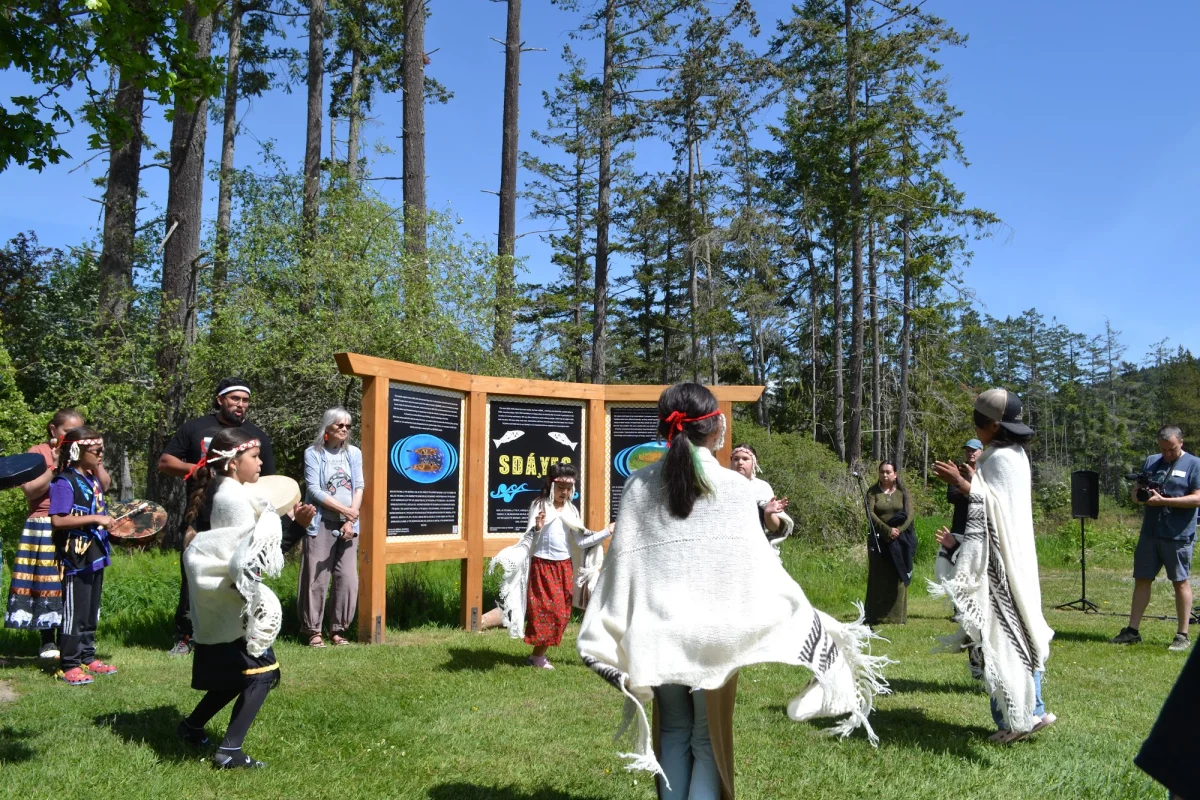
My blunder didn’t go unnoticed – and that’s a good thing. I was graciously asked to include the name, which is especially timely with the recent unveiling of gorgeous artistic and SENĆOŦEN additions to the island’s welcome sign, found at the intersection of Otter Bay and Bedwell Harbour roads, and new historical signs on the Community Hall grounds. An unveiling ceremony I attended, too, and by which I was deeply touched.
So, this month of June, National Indigenous History Month, I’m sharing with our readers a brief glossary of SENĆOŦEN and English names relating to the land and waters we call home, SDÁ,YES or Pender Island, and our Indigenous neighbours. (Note: pronunciations are approximate English guides only.)
- Located on W̱SÁNEĆ people’s ancestral homelands, pronounced somewhat like “wh-SAH-nuhch”. W̱ is a wind sound “wh”, and Ć is a “ch” at the front of the mouth.
- The Emerging People and Salt Water People both refer to the W̱SÁNEĆ people.
- Their language is SENĆOŦEN, pronounced “sen-CHOH-thun”.
- SDÁ,YES is Pender Islands’ name, translates to “a happy place to wind-dry fish” and refers to the practice of hanging salmon to dry in the island wind. Pronounced “st-AY…us”. The “…” for a pause like in “uh-oh” in English.
- SX̱IX̱ŦE is a sacred, ancestral reef-net fishing site near Bedwell Harbour, off South Pender. Pronounced “skw-ee-skw-ee-th-uh”.
- QENEṈ,IW̱ is the name of the ancient permanent village buried under Poets Cove Resort on South Pender, and of the adjacent reserve at Hay Point. Pronounced “kw-un-un…EE-wh”.
- SȾÁUTW̱ (Tsawout) and W̱SÍḴEM (Tseycum) are the two resident First Nations with recognized legal and ancestral ties to the reserve. Audio pronunciations of subtleties are available at https://niltuo.ca/community-names.
In the course of writing this glossary, I came across new-to-me information: six Hul’qumi’num-speaking Nations have deep historical ties to our island. I learned that both the W̱SÁNEĆ First Nations and the Hul’qumi’num Treaty Group hold inherent ancestral stewardship over these lands and waters.
It is a fascinating part of local history which I will, of course, be exploring further. For starters: Hul’qumi’num is pronounced “huhl-kuh-MEE…num” and Pender Island is called St’eyus, a shared name for a shared seasonal site for Coast Salish mariners.